
Eskilstuna
The SET-PED pilot in Eskilstuna has developed through a collaborative process that brought together local residents, the municipality, designers, researchers and technical partners.
Starting with the analysis of Fröslunda and the experiences of local users, the process gradually moved from identifying needs and opportunities to designing, building and installing the first SET-PED urban furniture prototype.
1. Understanding Fröslunda
First stages of the local process
The SET-PED process started with an assessment of Fröslunda and the creation of a local network of actors involving Eskilstuna Municipality, researchers, designers, technical stakeholders and community representatives.
Particular attention was given to the experiences of girls and young women. Through participatory activities, including the Urban Girls Walk, participants mapped everyday routes, identified places perceived as safe or unsafe and discussed what was missing from the neighbourhood’s public spaces.
The process highlighted several recurring needs: better lighting, places to sit and gather, protection from rain and sun, stronger social activity and more reasons for people to spend time in the area.

2. Turning local needs into a design concept
Spring 2026
The findings from the local analysis and co-creation process were translated into the first concept for the urban furniture prototype.
The selected site is located along an important walking and cycling connection between schools, housing areas, local services and Mötesplats Fröslunda. The area is also envisioned as the starting point for a future park.
The design responded directly to the priorities identified locally by combining seating, shelter and lighting in one modular structure. Circularity was embedded into the concept from the beginning, with the intention of using materials recovered locally and adapting the design to the resources already available.

3. Building with recovered materials
April–May 2026
During spring, the prototype moved into construction.
Different local material streams were brought together: granite blocks were used for the foundations, oak for the seating elements, reclaimed steel pipes for the supporting structure and fresh aspen timber for the curved roof frame. Recovered stainless steel was processed into the external roof cladding.
Working with reused materials required continuous adaptation. Each element had to be assessed, processed and fitted according to its existing dimensions and properties, turning the construction process itself into an experiment in circular design.
The curved timber roof was built through a process of bending, layering and tensioning fresh wood. Once the structure had dried and retained its final shape, the reclaimed metal sheets were fitted to the roof and the different parts of the prototype were assembled.

4. Testing and refining the prototype
May 2026
Before installation, the structure was tested to verify its performance and durability.
The roof underwent load testing using a 404 kg test load. The structure showed only minor temporary deflection and returned to its original position after the load was removed.
At the same time, the prototype continued to be refined in preparation for its presentation during the SET-PED conference in Eskilstuna on 26–27 May.
On 27 May, a local stakeholder workshop explored how smart and circular urban furniture could respond to different public-space needs across Eskilstuna. Participants discussed possible locations, users and functions, as well as accessibility, material reuse, energy integration and community value.

5. From prototype to public space
16 June 2026
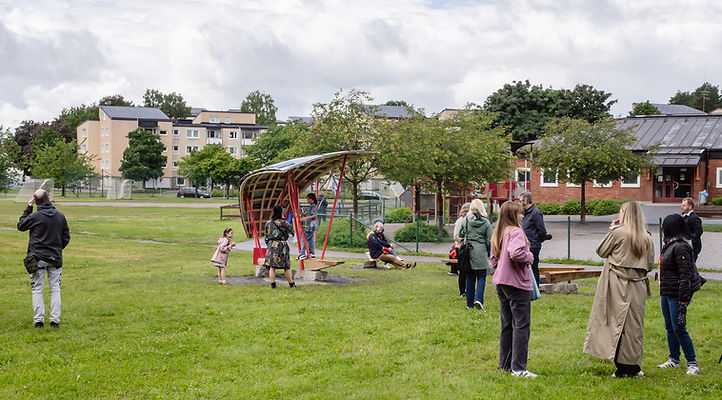
On 16 June, the first SET-PED urban furniture prototype was officially launched in Fröslunda.
The completed structure provides a sheltered place for sitting, resting and gathering along a frequently used pedestrian and cycling route. Its curved roof offers protection from rain and sun, while solar-powered lighting helps improve the comfort and visibility of the space.
The installation brings together the main elements developed throughout the local process: community needs, circular materials, technical experimentation and public-space design.
6. Learning from real-life use
Ongoing
Installation marks the beginning of a new phase of observation and learning.
The project will follow how the furniture is used, how the recovered materials perform over time, how the energy components function and how local users experience the intervention.
The experience gained in Fröslunda will help refine the SET-PED approach and provide practical knowledge on how circular, adaptable urban furniture can be developed, implemented and maintained in real public-space conditions.
See the Eskilstuna process in action
From local discussions and recovered materials to construction and installation, the Eskilstuna pilot brings together the different stages of the SET-PED approach.
Watch the video below to follow the development of the prototype and see how the intervention took shape in Fröslunda.

Background information on the SET-PED project in the Swedish national context
Project code: P2024-02856
Contract number: 2024-206254
Funded by: The Swedish Energy Agency (SWEA)
Project name (English): Synergizing Buildings Renovation and Regenerative Urban Furniture to Co-create PED Ecosystem
Project name (Swedish): Synergisera byggnadsrenovering och regenerativa stadsmöbler för att samskapa PED-ekosystem
Acronym: SET-PED Urban Furnitures
Local coordinator: Karin Stolt, landscape architect, Eskilstuna Municipality
The project is funded by SWEA under the Driving Urban Transition program, as part of DUT’s joint call for proposals 2023 / PED Transition Pathway, Topic 2: Urban Renewal and Renovation.