
SET-PED Annual Consortium Meeting in Eskilstuna: Advancing Circular and Regenerative Urban Futures
- setpedproject
- Jun 11
- 3 min read
The SET-PED consortium gathered in Eskilstuna, Sweden, for its annual consortium meeting, bringing together partners, pilot cities, and local stakeholders to reflect on progress and jointly shape the next steps of the project. Over two intensive days, discussions, site visits, and workshops highlighted how circular design, energy-smart systems, and co-creation are being translated into real urban solutions within one of SET-PED’s key pilot contexts.
Eskilstuna, a city known for its strong commitment to sustainability and circular economy practices, provided the ideal setting for this year’s meeting. The sessions were hosted in collaboration with Eskilstuna and local partners, including Energy Evolution Center, a hub dedicated to energy innovation, renewable solutions, and cross-sector collaboration.
Day 1: Project Progress, Collaboration, and Circular Inspiration
The first day of the consortium meeting focused on reviewing progress across all SET-PED work packages and aligning on the next implementation steps. Partners shared updates on key thematic strands, including circular renovation approaches, co-creation processes, regenerative urban furniture development, energy system integration, dissemination activities, and knowledge exchange across pilot cities.
A central feature of the day was the collaborative spirit: the discussions helped connect technical, social, and design-oriented dimensions of the project, ensuring that SET-PED’s ambitions are translated into coherent, place-based actions.
The consortium was warmly welcomed by Eskilstuna kommun, with special thanks to Karin Stolt and Rosaria Volpe for hosting and coordinating the event.

Site Visit: ReTuna – A Landmark in Circular Economy
One of the highlights of Day 1 was a visit to ReTuna Återbruksgalleria, widely recognized as the world’s first recycling mall. ReTuna demonstrates how reuse, repair, and upcycling can be embedded into everyday commercial and civic life, creating a living example of circular economy principles in action.
For the SET-PED consortium, the visit offered a strong source of inspiration. The project’s focus on circular urban furniture and regenerative design aligns closely with the systems already operating within ReTuna’s ecosystem, reinforcing the potential for scalable and community-driven circular solutions.

Day 2: From Prototype to Place – Local Implementation in Practice
The second day of the meeting shifted from strategic alignment to hands-on engagement with the Eskilstuna pilot implementation.
The day began with a visit to Eskilstuna Kommunfastigheter AB and its Activity, Motivation and Work unit (AMA). This initiative plays an important role in supporting individuals in their pathway toward employment or further education while actively contributing to the city’s circular economy.
Within the SET-PED context, AMA has been directly involved in the early stages of material sorting and preparation for reuse, particularly in connection with ReTuna’s ecosystem. This collaboration has enabled discarded materials to be transformed into valuable resources for urban applications.
Prototype Development and Urban Integration
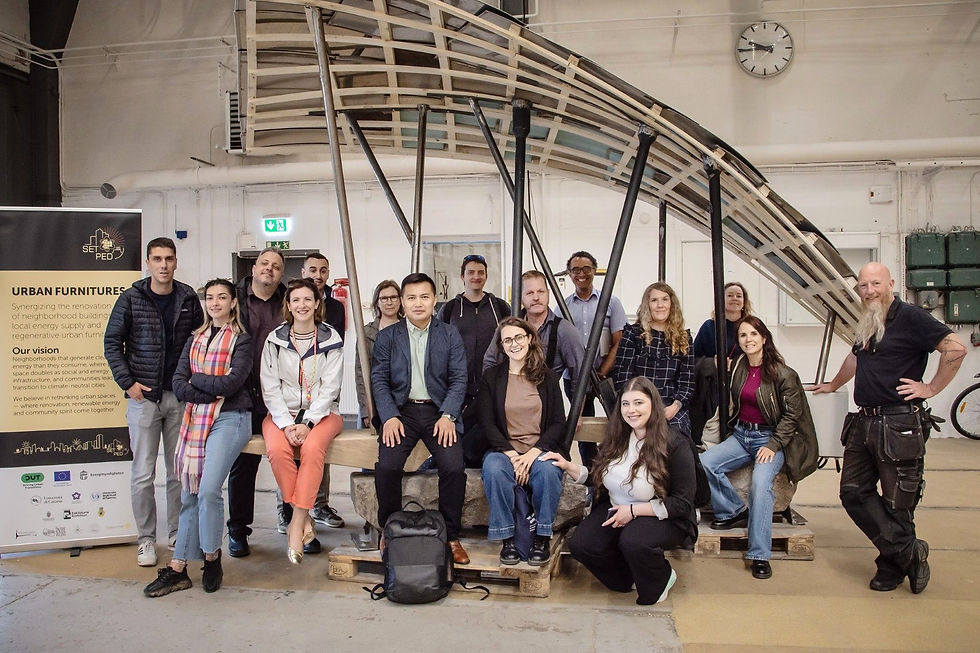
Partners also visited the site where the first SET-PED prototype has been developed and will later be implemented. This moment connected design and production work with its real-world urban context, making tangible the transition from reused materials to functional circular urban furniture.
The prototype itself was developed through close collaboration between project partners and local builders, including hands-on construction work led by Torsten Imottesjo. The process demonstrated how circular design principles can be operationalized through practical, place-based collaboration.
Stakeholder Workshop: Co-Creating Future Use Cases
In the afternoon, URBASOFIA facilitated a local stakeholder workshop focused on use-case scenarios for circular and smart urban furniture solutions in Eskilstuna.
The session brought together local actors to explore:
Potential locations for future installations
Target user groups and community needs
Functional requirements of urban furniture
Material and energy integration opportunities
Social and environmental impact pathways
These discussions provided valuable input for refining SET-PED use-case scenarios and supporting both local implementation and replication across other cities involved in the project.

Looking Ahead
The Eskilstuna consortium meeting reinforced the importance of integrating circular economy principles with urban innovation, community engagement, and practical implementation. By connecting strategic project development with real-world pilots, SET-PED continues to move from concept to impact.
The consortium extends its sincere thanks to all partners, local stakeholders, and contributors who made the meeting productive and inspiring. A special acknowledgment goes to Magnus Örnhammar for supporting dissemination efforts and documenting the event through photography.
As SET-PED moves forward, the insights from Eskilstuna will play a key role in shaping scalable, regenerative, and circular urban solutions across pilot cities and beyond.


Comments