
SET-PED Project in Eskilstuna: The first stages of a participatory urban process
- setpedproject
- Apr 17
- 5 min read
In Eskilstuna, the first stages of the European SET-PED project were carried out through a collaborative process coordinated by Eskilstuna Municipality and the Shared City Foundation, in close collaboration with Imottsjo architects, researchers from Dalarna University, and with support from local stakeholders including Jensen Education Eskilstuna, Tuna Entreprenad and K-fast. Together, these actors established a strong co-creation framework, conducted an in-depth assessment of Fröslunda, and activated a participatory process with young people to shape the development of solar-powered and circular urban furniture and installations, designed to strengthen safety, inclusion, and everyday quality in the area.
By combining technical expertise, local government perspective, and community anchoring - especially the lived experiences of girls and young women - Eskilstuna becomes an example of a participatory urban process oriented toward sustainable, inclusive, and climate-adaptive solutions, aligned with the Positive Energy District (PED) approach.
Co-creation as a central methodology (according to the SET-PED framework)
The co-creation phase established the methodological framework that guides the local implementation of SET-PED in Eskilstuna.
Through the Her City Toolbox, the working principles, relevant actors and how they contribute to the identification of needs, the modeling of use scenarios and the validation of decisions were defined. The framework includes clear steps – understanding the context, community involvement, site assessment and preparation of co-design – so that each intervention is both technically and socially sound.
Through this process, Eskilstuna Municipality strengthened collaboration between the administration, architects, researchers, technical experts and young residents, facilitating coherent collaboration in the following stages.

Evaluation of public spaces and selection of the optimal location
The chosen location for the project is Fröslunda, which is prioritised in Eskilstuna's strategy for urban healing. The overall goal is to improve the quality of life in socio-economically disadvantaged areas.The evaluation phase combined community perceptions, technical observations, and participatory assessment, in line with the Her City methodology.
2.1. Activating the local network of actors
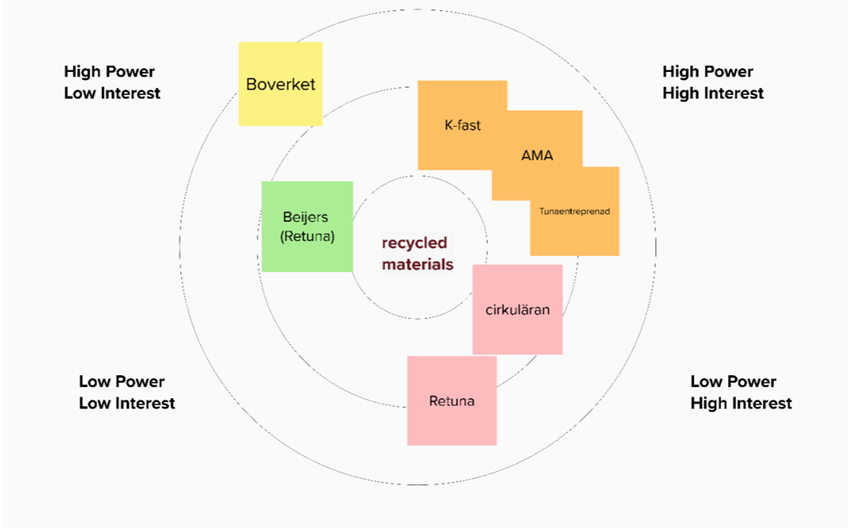
The first stage of the project aimed at building a local network of actors capable of supporting the process of co-creation, analysis and implementation.
The network was designed in a layered manner, to bring together:
municipal actors and departments within Eskilstuna Municipality,
research partners (Dalarna University and others),
technical and construction stakeholders (e.g., Tuna Entreprenad, K-fast),
architectural expertise (Imottesjo),
and civic/community actors connected to Fröslunda.
This structure functions as a coordination system: it supports decision-making, ensures coherence between community needs and technical requirements, and provides a stable framework for future phases of the project. The network is dynamic, constantly updated as new relevant partners emerge or as creative stages are advanced.
The activation of the network also allowed the alignment of City Hall departments with external experts and the community, so that the prototype that will be installed in Fröslunda would be not only technically feasible, but also socially accepted and easy to maintain.

In addition to local coordination activities, the network was strengthened through participation in international SET-PED exchanges, where participatory approaches and community activation strategies were discussed and shared across pilot cities.
2.2. Her City Workshop - Real community perceptions from girls and young women
The next step consisted of collecting direct engagement with young people, particularly girls, whose experiences of public space are often underrepresented in planning processes.A total of 30 participants, including 25 girls aged 17–18, were invited to explore, evaluate and envision Fröslunda’s public spaces together with architects, civil servants and entrepreneurs. The participants were students at Jensen Gymnasium, with diverse cultural backgrounds and varying relationships to Fröslunda.

The Urban Girls Walk tool provided a structured qualitative framework based on 13 public space indicators, including accessibility, lighting and visibility, social inclusion, representation, multifunctionality, infrastructure quality, and proximity to services. Kobo Collect was used to geolocate observations and systematically document site-specific findings. Through these tools, participants mapped and documented:
· routes and everyday movement patterns
· areas perceived as safe or unsafe
· places lacking seating, lighting, shade or social activity
· and spaces with potential for solar-powered furniture and installations.
The participants identified Fröslunda as a place with significant potential, yet currently marked by exclusion, insecurity and a lack of reasons to stay. The assessment also revealed a gendered pattern of spatial use, where girls and young women feel underrepresented in the area, particularly outside school hours.
The Urban Girls Walk tool provided a structured qualitative framework based on 13 public space indicators, including accessibility, lighting and visibility, social inclusion, representation, multifunctionality, infrastructure quality, and proximity to services. Kobo Collect was used to geolocate observations and systematically document site-specific findings. Through these tools, participants mapped and documented:
· routes and everyday movement patterns
· areas perceived as safe or unsafe
· places lacking seating, lighting, shade or social activity
· and spaces with potential for solar-powered furniture and installations.
The participants identified Fröslunda as a place with significant potential, yet currently marked by exclusion, insecurity and a lack of reasons to stay. The assessment also revealed a gendered pattern of spatial use, where girls and young women feel underrepresented in the area, particularly outside school hours.
needs and priorities,
a shared vision for the area,
and concrete design proposals for future installations.
This participatory process confirmed that Fröslunda requires not only physical upgrades, but interventions that strengthen:
safety through lighting and visibility,
social life through gathering spaces and activities,
identity through art, color and local representation,
and inclusion through design for all ages and abilities.

The proposals and concept ideas developed by the participants have been submitted to the project consortium’s architect, who will develop a design proposal for installations—including solar-powered urban furniture—to be built and tested on site.
Prioritised areas

Prioritised installations
1 | 2 | 3 | 4 | 5 | 6 | |
Lighting | ||||||
Flowers | ||||||
Seating with tables and roof | ||||||
Café | ||||||
Fountain (for drinking & decoration) | ||||||
Photo booth | ||||||
Colour | ||||||
Pathway across the field | ||||||
Fenced football field with artificial grass | ||||||
Ice rink | ||||||
Playground for (all ages) | ||||||
Light installations and art | ||||||
Marketplace | ||||||
Place to gather/Hangout | ||||||
Parasol | ||||||
Stage/Screen/Theater/dance | ||||||
Sun loungers | ||||||
Big swings | ||||||
Toilets | ||||||
Surveillance camera/Staff |
Idea sketches based on the modells


Stages carried out in Fröslunda
The SET-PED process in Eskilstuna has progressed through three main stages, each documented by specific reports that can be consulted in detail.
1.Establishing the co-creation framework
This stage defined the working methodology, the principles of co-creation and the way of organizing the actors involved. The necessary steps for assessing the urban context, engaging the community and preparing the participatory design process were clarified.
2.Activation of the local network of actors
Following the establishment of the co-creation framework, stakeholder mapping and activation were carried out to build a local network of actors capable of supporting the process of co-creation, analysis and implementation.
A multi-stakeholder network was consolidated in Eskilstuna, bringing together municipal departments, academic partners, architects, technical stakeholders and community actors connected to Fröslunda. This structure supports coordinated decision-making, ensures coherence between community needs and technical requirements, and provides a stable framework for future phases of the project.
3.Analysis of public spaces and selection of the optimal location
The Fröslunda area was assessed through a combined social and technical analysis. The process included participatory mapping using Urban Girls Walk and Kobo Collect, co-creation workshops using MethodKit, and professional site observations focusing on accessibility, lighting, spatial use, solar exposure and infrastructure gaps.
The integrated assessment confirmed Fröslunda as the demonstration site for testing solar-powered and circular urban furniture prototypes.
Conclusion
Through these first steps, Eskilstuna built a solid foundation for the development of solar-powered, circular and climate-adaptive urban furniture and installations in Fröslunda.The process was guided by co-creation, grounded in the lived experiences of girls and young women, supported by technical and academic expertise, and anchored in a local network of stakeholders.In 2026, the project enters the creative phase, in which use scenarios, design and prototyping will transform the conclusions of these analyses into a real intervention, located in Fröslunda.


Comments